Chapter 3. A Cross-Copy Close Reading of the T Portraits
As discussed in the Introduction to this dissertation (sections ‘Why Version T?’ and ‘Cross-Copy Reading & the Difference It Makes’), previous scholars have reached contrasting conclusions about the meaning and audience of Version T of La Vie de sainte Marie l’Égyptienne as a result of their choice of source material. Simon Gaunt, for instance, frames the Vie as a text offering “men the double pleasure of enjoying the spectacle of Marie’s beautiful body and her sexual adventures, then witnessing the disintegration of her beauty, the just reward for her debauchery” (219). In Gaunt’s account, Version T primarily serves an unsympathetic male audience who may feel both sexual arousal and a schadenfreude infused with misogyny. Élisabeth Pinto-Mathieu more gently but similarly suggests the target audience would have been lay women “tentées par le siècle” (90) and in need of hagiographical texts to instruct and edify them. Whether for a male or female public, these readings each presume an audience that perceives womankind as both sexually threatening and sexually threatened and in need of severe correction. In that vein, Version T’s Mary the Egyptian is an extreme model of what-not-to-do and who-not-to-be or else — an interpretation only barely softened by the prologue’s acknowledgment that all may be saved by God no matter the gravity of their sins. Alternatively Emma Campbell and Duncan Robertson each resist such constrictive readings. As noted earlier (Introduction, section ‘Why Version T?’), Campbell argues in favor of T’s queer affirmation of spiritual community in which Mary the Egyptian is not a threat to Christian brotherhood; rather than corrupt, she sets a Christian example (164). Robertson’s body of work on Version T likewise challenges unsympathetic interpretations, writing of female saints in general: “These women are all autonomous, active figures — not victims or objects but subjects of religious experiences, who invoke the reader’s interest, concern, sympathy, admiration, empathy, and eventual imitation” (“‘Cume lur cumpaine et lur veisine’” 15-16). My own view aligns closely with Robertson’s: through a deliberate comingling of theological and emotional appeal, the T-poet invites audiences — male, female, or otherwise — to identify with Mary, to admire her, to desire her, and in so doing to find themselves within the Christian fold. While Gaunt and Pinto-Mathieu each based their readings of Version T on Dembowski’s print edition — and therefore draw their evidence almost exclusively from manuscript copy T-A — Campbell and Robertson grounded their interpretations in the wider manuscript corpus, a practice that productively complicates our understanding of Version T’s Mary the Egyptian. Reading across the full range of surviving witnesses compels us to test our assumptions about the text against its material evidence and to confront the diversity of interpretive possibilities the T corpus sustains. This chapter examines in particular the two T portraits as they appear across the available manuscript copies, using the digital edition and translations introduced in Chapter 2 to inform a comparative close reading that draws upon the full body of material evidence to reveal how different textual communities continually reshaped the figure of Mary the Egyptian.
The close reading of this chapter is based on the T portraits as defined in Chapter 2 (Portrait 1 vv.157-216 and Portrait 2 vv.613-700). Yet even drawing such firm boundaries around these passages risks obscuring how the manuscripts themselves frame them. In the surviving copies of Version T, decorated initials guide readers’ eyes to new scenes or signal passages of heightened importance.1 Several manuscripts — T-C, T-D, and fragment T-F1 — introduce Portrait 1 with an accentuated ‘D,’ visually foregrounding the ensuing description of Mary’s beauty and her many alluring qualities:
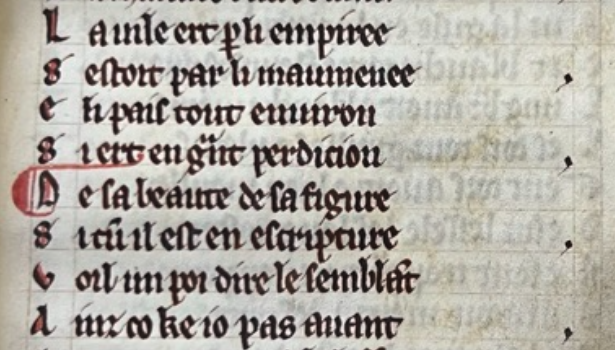
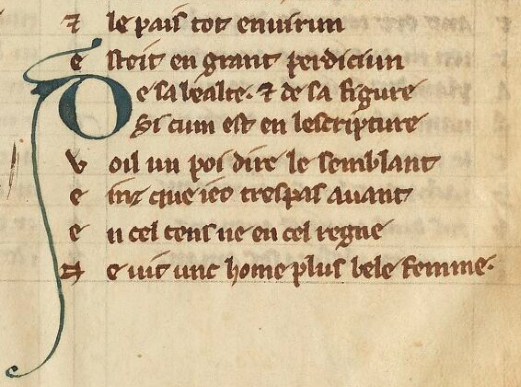
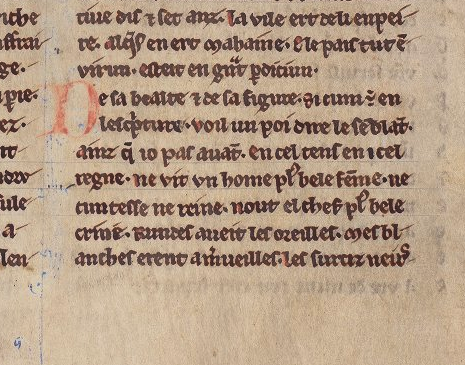
The other witnesses that contain the scene, however, avoid using any decoration near it (T-B) or position decorative initials just before this moment. In T-A and T-E, the decorative initials mark Mary’s presence in Alexandria and the account of her ‘occupation’ there rather than the portrayal of her figure:
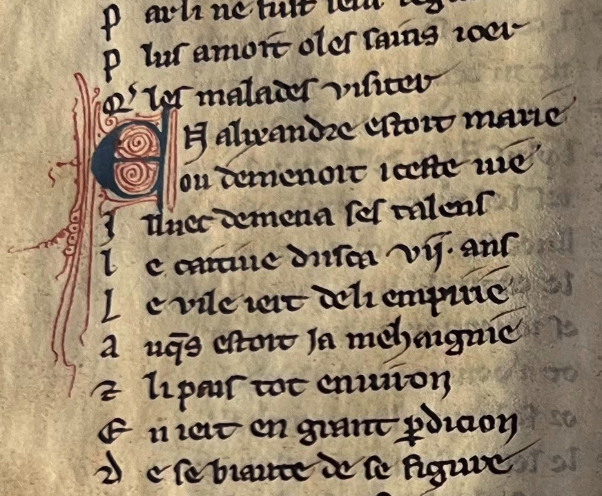
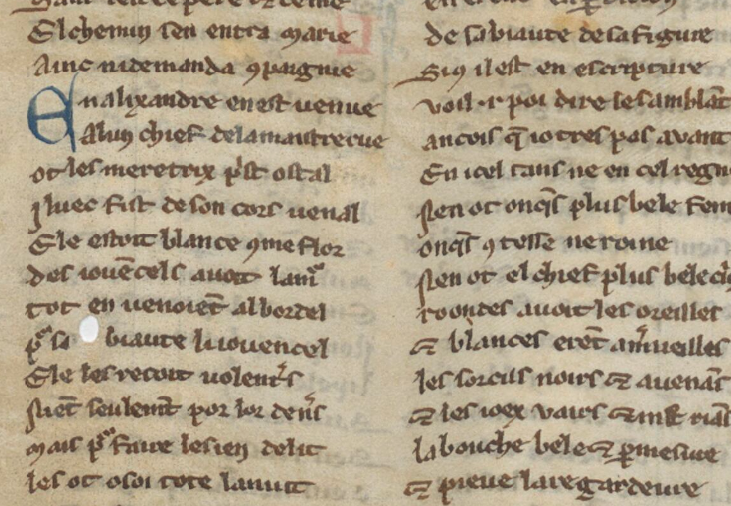
This variation subtly shifts each copy’s interpretive focus. Whereas T-C, T-D, and T-F1 draw immediate attention to Mary’s physical appearance, T-A and T-E frame her through her actions, prompting readers to dwell first on her sin and its social consequences — men slaughtering one another and the wise of the city lamenting her wasted youth — before attending to her beauty. Such visual cues could incline readers of T-A and T-E toward a harsher moral judgment of Mary, or at least to view her allure as secondary to her actions, while readers of T-C, T-D, and T-F1 might first encounter her with admiration and perhaps sympathy. The differing placements of these initials may seem minor, but they exemplify how the material features of the manuscripts may quietly shape interpretation. Attending to these paratextual details reveals how scribes could redirect emphasis within copies of the ‘same’ text, subtly guiding a reader’s moral and emotional attention.
The influence of these manuscript features extends even into the modern editorial practice. In his edition of Version T, Dembowski often follows the layout of his base manuscript, T-A, inserting paragraph indents rather than recording the presence or placement of decorative initials. These indents frequently occur where initials appear in T-A, though not always,2 and they serve a similar visual function: to mark a new episode or scene or focus. In keeping with T-A, Dembowski introduces a paragraph break with the verse “En Alixandre estoit Marie” (v.149), corresponding to the decorative initial that appears there in T-A but not in the majority of other manuscript witnesses. As a result, readers of his print edition are prompted — just as readers of the manuscript are — to focus first on Mary’s presence in Alexandria and her sinful activity there, rather than on the description of her beauty that most other manuscripts foreground. In the absence of the manuscripts themselves or digital surrogates that reproduce their layout, readers must rely on the editor’s visual cues to navigate the text — to recognize when scenes begin or end and where to shift interpretive attention. Such seemingly neutral typographical decisions — paragraphing, spacing, indentation — can reproduce biases and should motivate editors to provide readers with as much information as possible. In the editing of medieval texts, more is more.
By tracing both continuity and variance across manuscript copies of the ‘same’ text — the T portraits — we may catch glimpses into what features of the text appear to be the most essential and what features might be considered more mutable by manuscript copyists depending on the local context in which the copy was produced.3 When reading the portraits of Mary the Egyptian across copies of Version T, what details remain constant and where do we find inconsistencies that invite us to probe further? Reading across the manuscript copies enables us to more confidently address challenging questions such as: Who were Version T’s target audiences? What purposes does Version T serve? Such a reading also allows us to explore questions relating to how much copyists across time and space agree on central elements of the work: what is the nature of Mary’s character? Does Mary’s turn to asceticism come out of nowhere, or are the prerequisites for saintliness perceptible even in her seemingly most callous and prideful form? Does Mary exclusively experience suffering in the desert? When is Mary most content? And when and why is she most desirable and beautiful?
The close reading in this chapter is also informed by Alice Colby’s The Portrait in Twelfth-Century French Literature: An Example of the Stylistic Originality of Chrétien de Troyes (1965), which provides a critical survey and analysis of literary portraiture in twelfth-century French romance — a systematic study yet to be replaced by more recent scholarship. Colby identifies the formal and thematic features of descriptions of handsome men, beautiful women, and ugly creatures, outlining the cues by which a contemporary audience would have recognized character type and moral value. As Colby observes:
… although the portrait does very little to help us see fictional characters as individuals, it gives us more general information about them than an uninitiated modern reader might think. Upon hearing the portrait of a handsome person, a twelfth-century listener knew immediately that this person was going to play at least a fairly important part of the story, that he was of noble birth and reasonably young, and that he was basically of good character and therefore deserved the listener’s sympathetic interest in all his undertakings. If, on the contrary, the individual was said to be ugly, the listener had good reason to suspect that he would play an important but unpleasant role in the story and that, being wicked, he merited no sympathy whatsoever. A deliberate exception to this rule such as the portrait of the Giant Herdsman or that of Partonopeus must have been a very effective means of surprising the listener. (99)
Although writing in this twelfth-century context and clearly drawing upon these recognizable models of description from romance, the T-poet retools them in their descriptions of Mary to subvert expectations and surprise the reader/listener. Portrait 1 aligns Mary perfectly with the romance ideals of feminine beauty — all the common traits of physical beauty as well as youth, nobility, and eloquence —4 qualities that signaled virtue and a worthiness of sympathy. Yet the T-poet subverts this association: Mary is most traditionally charming precisely when she is most wicked — a misalignment that might prompt both uneasiness and intrigue in the audience. In Portrait 2, the T-poet applies the romance conventions mostly closely associated with ‘ugly creatures,’ but in this second portrait, Mary is no monstrous figure; she remains alluring and spiritually radiant. The T-poet underscores how desire itself can be reoriented toward the sacred. The T-poet is taking a familiar formula and twisting it; a device that in romance might more clearly signal moral type becomes in Version T a means of poetically rendering conversion and the paradoxical beauty of holiness.5
Affirmation & Negation
We might, first, consider the T-poet’s use of negation when describing the saint across Portraits 1 (vv.157-216) and 2 (vv.613-700). How does the poet say what Mary the Egyptian is versus what she isn’t, what she does and doesn’t do? Across all of the T copies, there is an almost uniform use of negation in these portraits with a noticeable shift in the function of negation occurring from the first to the second portrait.
In conformity with the topos of indescribability outlined by Colby,6 in Portrait 1, Mary the Egyptian is hyperbolically described as indescribable: no man has ever seen a more beautiful woman (v.162).7 No countess or queen has ever had such beautiful hair (vv.163-164).8 No one could ever begin to capture her beauty in writing (vv.186-188).9 And similarly in Portrait 1, Mary is often neither this nor that: she is neither too big nor too small (v.185);10 There is nothing about her to improve (v.190).11 But in Portrait 2, Mary is never indescribable. She is affirmatively just as the narrator describes her to be, and in that sense, Mary the Egyptian is paradoxically far more seeable, knowable, and comprehensible as a figure to the reader in her more spiritual form as opposed to her more sexualized form. It is as though she has been truly exposed and stripped bare to her unadorned self by the elements of the desert.
Negation is still used in Portrait 2 but primarily to list the many material possessions that Mary the Egyptian lives without as well as to note the actions she does not perform. Mary is without belongings in Portrait 2, but most importantly, she is without need of belongings. She does not have nice clothing (v.624),12 pride (v.636),13 voluptuous flesh (v.643-644),14 extra provisions (vv.665 & 667),15 or even a vessel for drinking water (v.678).16 She does not provide herself with more than what is absolutely necessary (v.676),17 but she is provided for. After finishing her little loaves of bread (v.667-673),18 she grazes on grasses and roots (vv.674 & 681),19 she drinks directly from streams (v.677),20 she eats what God’s angel brings to her personally (v.683-684),21 and she finds abundant shelter (v.699).22 Negation is strategically used in Portrait 2 to emphasize key actions that Mary does not do, to her own benefit: She never forgets the Virgin, her guarantor (vv.617-620),23 she does not bemoan her sins (vv.679-680)24 or avoid her penance (v.653),25 — and in this mindset, the narrator affirms she is not wrong (v.656) —26 she does not think of folly (vv.693-694),27 and she is never bothered by any beast or creature (vv.695-697).28 What she does do in Portrait 2 is travel in surety (v.698)29 and live spiritually (v.700).30 The hardships she endures are no longer burdens but are embraced as essentials. Portrait 2 vividly captures this shift; Mary is depicted as blessed amidst her trials (vv.691-692),31 secure in the knowledge of her progress, and confident in her newfound purpose. She does not lament her past sins but views her austere conditions as liberating and transformative, indicating a significant move from fleeting material pleasures to infinite spiritual fulfillment. In contrast, throughout Portrait 1, Mary’s actions are almost exclusively to possess material goods and to be possessed as a material good. Mary’s entire existence serves only fleeting pleasure: she receives gifts (v.193) and buys clothes (v.194)32 but only to decorate her body in order to better please her lovers (v.196),33 and had she not chosen a path so full of folly (v.210),34 then the best she could hope for would be to be honorably taken by an emperor (vv.215-216).35 Just as Mary cares nothing for woollen clothes (v.197),36 she equally cares nothing for her Creator (v.192).37 In Portrait 1, Mary’s life is presented as nothing but purposeless vanity.
From Top to Bottom
With regard to descriptions of Mary’s physical features, we likewise mostly find continuity in the portraits across the T copies, suggesting that the precision of these descriptive details serve not only an aesthetic function but also convey the text’s message.
In alignment with the model of such portraits appearing in courtly romances contemporary with Version T, Portrait 1 presents Mary’s body in meticulous detail, scanning her figure from top to bottom with a particular fixation on her upper half.38 While some might perceive Portrait 1’s mode of description as lascivious,39 Portrait 1’s fixation on the details of Mary’s upper body is poetically justified by the fact that she is wearing a bliaut, which would cling around the torso and upper arms, giving both areas greater definition to the viewer, with a skirt and lower sleeves that would obscure the shape of her lower half and upper extremities.40 Colby’s analysis of twelfth-century romance portraits supports this justification and finds nothing concerning about the inclusion of descriptions of the female form:
It may have been considered indecent to give a graphic description of the belly, legs, feet, and toenails; but it is also true that these parts of the body were ordinarily covered by clothing and that the portraits were often not detailed enough to include them. Moreover, we must not forget that writers had no qualms about depicting the breasts; and one poet even mentions the pudenda. (96)
Across the T copies, the precise details of Mary’s clothing are always the same, including a fine purple silk bliaut (v.199),41 an ermine mantle (v.200),42 and Cordovan leather shoes (v.201).43 The detail of her fine shoes prefigures her eventual barefootedness in Portrait 2, and the ermine mantle foreshadows the way in which her long white hair eventually drapes over her entire body during her decades of nakedness.
Portrait 2 mostly follows this same top-down pattern but disrupts the more simplistic directionality of the first portrait to demonstrate how Mary’s profound spiritual transformation has manifested itself physically. Whereas Portrait 1 remains fixated almost entirely on Mary’s upper body, Portrait 2 moves from the outside in, beginning initially with the wearing away of Mary’s clothing (v.622) — and in particular her shoes (v.621) —44 then taking the time to emphasize her changed skin (vv.625-628),45 before progressing to the more traditional top-down listing of features in parallel with Portrait 1, indicating clearly how every last aspect of her body has been transformed so dramatically by her asceticism. In this way, the poet first peels back Mary’s obscuring layers — her clothing and her skin — before providing a fuller picture of her form. Unlike Portrait 1, which generally refrains from discussing her lower body, Portrait 2 gives significant attention to the state of Mary’s feet, which are split (v.651)46 and wounded (v.652)47 to indicate her humility. Portrait 2 also grants Mary’s body a greater sense of movement and position in space as she roams about in the wilderness. In every copy except T-B, she drinks directly from the stream — in almost every case while lying prone on the ground (v.677) —48 yet another clear indicator of her profound humility and a total upending of her former life of lying in soft beds,49 as well as proof of how literally grounded she has become.
There is, however, one detail from copy T-A of Portrait 1 that slightly disrupts the top to bottom pattern of description and is worth mentioning because it would most likely go unnoticed by readers of the Dembowski edition. Copy T-A is the only copy to mention Mary’s foot in Portrait 1, making it the only copy to reference any feature of her lower body in the first portrait:
T-A: “& le pié & le regardeure” (v.170) → “and her foot and her expression” (v.170)
T-B: “mut avoit piue regardure” (v.165) → “She had such a pleasing expression” (v.165)
T-C: “e simple avoit la regardure” (v.172) → “and she had a simple expression” (v.172)
T-D: “& pie la regardeure” (v.168) → “and pleasing her expression” (v.168)
T-E: “& pieue la regardeure” (v.170) → “and pleasing her expression” (v.170)
T-L: “Et piue le regardeüre” (v.???) → “and pleasing her expression”50 (v.???)
T-F1: [offers only the first 10.5 verses of Portrait 1]
T-F2: [both portraits missing]
And with this brief mention of the beauty of Mary’s foot, the reader of copy T-A is perhaps prompted to more readily appreciate the total transformation of Mary’s feet in Portrait 2, which are so emblematic of her pious humility. However in his print edition, Dembowski renders the verse “Et pie le regardeüre” (v.170) quietly altering what is actually present in the manuscript of his base text, copy T-A, in order to more closely conform to the verse as it appears in copies T-D, T-E, and — apparently — T-L.51 In his “Corrections apportées au ms. A et notes,” Dembowski documents the original verse from the manuscript with “ms. Et te pie et le r. —” (67n170),52 and in his “Variantes” section, he indicates the variants for all other copies,53 but there is no in-text indication signalling this change. The print reader may only notice something is afoot by carefully cross referencing both the corrections section — where the line has been incorrectly transcribed — and the variants section — where T-A is not mentioned at all. Without any other resources (access to the manuscript itself, some facsimile of the manuscript, or an alternative transcription), the reader must accept Dembowski’s edit as fact, thereby erasing any other valid possibilities for this verse.
This quiet emendation may be small, but it is a prime example of what feeds the crisis of authenticity previously addressed in Chapter 1 (section 2. Ephemeral & Error-prone) in which the real problem with our editions (both print and digital) is not that texts contain errors or have been changed but that they have been changed silently. Without alternative avenues of access, the reader can only trust the authority of the editor who may make such decisions without notice and without explanation. The digital edition of this dissertation addresses the silent emendations problem by connecting the reader to digital surrogates (where possible), by presenting transcriptions with clearly delineated levels of interpretation (Appendix 2), and by presenting unique translations adapted to the contents of each manuscript copy (Chapter 2.2). In this way, these materials offer the sort of environment of layered affordances (advocated for in Chapter 1, section 2. [Im]material & [In]human) that encourages communal scrutiny — something a print edition cannot as easily reproduce. Rather than brush variance aside as a distraction to our readings, we may take every detail of Mary’s body — from head to toe — into account as we consider the multiple iterations of her saintly body across the whole T corpus.
Whiteness & Blackness
Perhaps the most shocking bodily transformation Mary undergoes is the dramatic shift in her coloring from whiteness to blackness — a stark, easily recognizable manifestation of her spiritual journey, resonant with theological implications (as Duncan Robertson has already convincingly argued, the T-poet was likely influenced by Bernard of Clairvaux’s Sermon on the Song of Songs in which the bride is black but beautiful [“Twelfth-Century Literary Experience” 76].) In every copy of Version T, the first physical descriptor provided in reference to Mary indicates her whiteness (v.113),54 though because this characteristic first appears in the exact moment of Mary’s arrival at the brothel in Alexandria, this otherwise visual cue is most likely intended to signal Mary’s youth and purity as an abstract evaluation of her innocence rather than a commentary on her overall appearance. The juxtaposition of white and black is played with to great effect throughout both portraits with little variance across the T copies, but some notable exceptions to this continuity invite further reflection. For instance, T-B is the only copy to omit the couplet mentioning Mary’s original blond hair color in Portrait 1 (vv.175-176),55 maintaining the only other hair detail in Portrait 1 that her eyebrows are black (v.168).56 Given that Portrait 1 reflects beauty standards common in contemporary courtly romances, a medieval reader of copy T-B may have easily passed over this omission, having already envisioned a blonde beauty without having to be explicitly told that she is blonde. However, this omission might perplex a modern reader — particularly one not versed in twelfth-century aesthetics — who, in the absence of specific cues, could interpret her transformation in Portrait 2 as a pure photographic negative — from white skin with presumably black hair to black skin with white hair.57 Such nuances subtly alter the visual impact of Mary’s transformation, which, while not a perfect photographic negative, is still quite dramatic. Without access to the other T copies — or without, at least, the guidance of an editor willing and able to provide variant notes for the particularly attentive reader to find —58 a modern reader might be tempted to draw and perpetuate such an unsupported conclusion. Believing that the ascetic Mary is the pure and total opposite of the luxurious Mary — just as white and black are literal and symbolic opposites — readers of T-B might neglect to observe the continuities discernible in her from Portrait 1 to Portrait 2 such as her ability to withstand extreme lifestyles, her aptitude for bodily sacrifice, and the enduring allure of her figure. In neither portrait is Mary wholly black or white, and in neither portrait is the Mary the Egyptian of Version T an ‘ugly’ creature. In both portraits, her simultaneous whiteness and blackness is indicative of her paradoxical nature, of her ability to manifest contradictory identities in one body at once.
As opposed to Portrait 1 in which Mary’s coloring is presented more statically, an emphasis on the act of changing color is particularly noticeable in Portrait 2. In Portrait 1, Mary’s features are simply white, but in Portrait 2, her sides blacken,59 her flesh changes,60 her hair changes color, becoming white like ermine,61 her face is burned,62 the flesh around her mouth blackens,63 her chest is black and changed,64 and the narrator remarks on the inevitability of her blackening under such harsh conditions.65 This consistent use of dynamic verbs like ‘blacken’ underscores the significance of the transformation process itself as Mary is reformed, rather than the mere fact of being one color or the other. Mary the Egyptian’s saintliness stems from her ability to shift from one extreme to the other, but the fact of her ability to change at all despite her past is crucial to the message of Version T as stated plainly in the prologue that all are capable and worthy of redemption if only spurred into action (vv.13-22).66 The broader symbolic implications of the colors white and black in this context are well worth exploring in more depth elsewhere,67 but at a minimum, it is clear that Mary’s color transformation is meant to be perceived as an extreme change — perhaps inimitable physically but certainly replicable metaphorically for a devout reader.
Apples, Roses, & Thorns
Descriptions of Mary’s body in the portraits across the copies are largely consistent, but there are some subtle yet significant variations that, when probed further, can complicate our reading and enhance our theological understanding of the legend as represented by Version T. The likeness of Mary’s bodily features to nature is a recurring motif in both of the portraits, especially through weighty symbols like apples, roses, and thorns, which not only enrich the depiction of Mary but also strategically align her with the Biblical figures of Eve, the Virgin, and Christ himself. First, the consistent placement of “dame” and “pome” in the end rhyme position of the couplet “Les mameles de cele dame / N’estoient menrres d’une pome” (vv.177-178)68 across the manuscript copies in Portrait 1 reinforces the metaphorical importance of explicitly linking woman to apple and thus Mary the Egyptian to Eve, the original temptress and mother of all. However, the image of the apple is not exactly equally deployed across the manuscript copies, subtly influencing both the perception of Mary’s eroticization and the implications of her eroticization. Although Portrait 1 in copy T-B does provide some description of her breasts,69 T-B omits the specific comparison to apples entirely, thereby somewhat diminishing Mary’s symbolic link to Eve. And while copies T-C, T-D, and T-E each suggest that Mary’s breasts are no larger than apples, implying a more modest chest size, copy T-A states that they are no smaller than apples, suggesting a more ample form in the sexually active young woman. This slight variance among the extant T copies has the potential to shape our mental image of Mary and thus our understanding of the T-poet’s possible intentions: Is Mary a buxom fantasy, written for the erotic pleasure of the reader? A petite and modest young woman corrupted by the world? If we had only T-A at our disposal, we might be tempted to dismiss this initial portrait and Mary’s various other sexual acts throughout the narrative as mere pornography,70 but given that most copies downplay the size of Mary’s figure, and refer rather obliquely to her sins of the flesh, it seems more justifiable to see Mary — even in the throes of her sin — as symbolic of much more than the cause of the fall of some forty men in Alexandria.
Regardless of their actual size, the comparison of Mary the Egyptian’s breasts to apples during her period of sinfulness evokes a sense of temptation but also fullness, firmness, freshness, and vitality. Conversely, the later comparison of Mary’s flattened chest to bark, in the second portrait,71 shifts our attention from the fruit to the wood of a tree and underscores the profound sacrifice of her flesh. Unlike the nurturing and potentially reproductive function of fruit, the image of bark suggests endurance and barrenness. The sacrifice of her own flesh — both perversely when Mary is offering up her body sexually and when she is offering up her body spiritually — connects Mary the Egyptian to both the Virgin and Christ. The Virgin Mary, as the New Eve, brought comfort and salvation to the world with her body through her role in the incarnation and the sacrifice of her son, while Christ’s ultimate bodily sacrifice paid for the sins of mankind on the wood of the cross.
Mary the Egyptian’s connection to Mary the Virgin is made plain in Version T by way of Mary’s lengthy prayer to her namesake (vv.413-538), but even before Mary’s epiphany in the holy land, Portrait 1 offers a compelling link between Mary and the Virgin via the image of the rose. In every manuscript copy, Mary the Egyptian’s blushing complexion is compared to a fresh rose,72 but T-B alters this couplet slightly, offering the reader the unique suggestion that Mary is not yet in full bloom but is still concealed with the alteration of the end rhyme coloree/nee to celee/nee.73 In addition to perhaps emphasizing Mary’s youth at this early stage,74 T-B slightly enhances the thematic significance of Mary the Egyptian’s initial concealment and eventual revelation, setting up her physical and spiritual unveiling in the desert — a reversal of Eve’s need to cover herself upon realizing her nakedness and perhaps also interpretable as another connection to the Virgin birth as Christ was first concealed in the womb before being revealed to the world in human flesh. And just as the portrait descriptions of Mary’s body progress from the top downward, the full body of the ‘rose’ is revealed in Version T in a top-down manner: first linking Mary the Egyptian to the flowering bloom at the top in Portrait 1 and then to the thorns of the stem beneath in Portrait 2. The image of the rose in Portrait 1 foreshadows Mary’s penitential journey in which her bare feet are repeatedly pricked by thorns in Portrait 2 all while under the protection of the Virgin.75
As Mary the Egyptian traverses the wilderness, the thorns that prick her not only metaphorically link her to the Virgin Mary’s role in the redemption of Original Sin, but also mimic the suffering of Christ both as he wandered the Judean desert for forty days and later as his crown of thorns increased his suffering during the crucifixion. Thus, Mary the Egyptian’s personal narrative arc from sin to sanctity over the course of her lifetime mirrors the passage of Biblical time, tracing the initial fall of man via the temptation of Eve to his redemption by Christ by way of the Virgin. Paradoxically, had Mary the Egyptian never sinned so greatly, she never could have chosen to reach such a profound level of humility and ultimately redemption. Eve (Mary) had to ‘eat the apple’ in the first place in order to set in motion humanity’s march toward the redemption that could only be delivered via the sacred rose, the New Eve, the Virgin Mary. Version T not only makes the comforting message clear that even the most misguided of sinners may be saved if they want to be, but poetically poses the greater theological argument that it is through both the sins of Eve and the virtues of the Virgin that it is even possible for believers to choose to be saved by Christ.76
Reading Mary’s Bodies Across the T Corpus
| Le figure vit de Marie | He saw the figure of Mary. |
|---|---|
| De Marie vit le figure | From Mary, he saw the figure |
| Apertement sans covreture | Openly without covering. (vv.837-839) |
In this moment when Zozimas first encounters Mary in the desert, Zozimas both sees Mary’s physical body and what her body represents figuratively. Although Zozimas initially struggles to recognize Mary and even fears her,77 the reader — who, by now, is intimately familiar with Mary — is assured that the beauty of her body is in alignment with her saintly nature. She is no longer merely an attractive woman but an irresistible concept. She is now the embodiment of God’s grace, the free and unmerited favor bestowed upon all sinners. The narrator specifies that God wanted to bring Mary here in this moment because He no longer wished that she be hidden: “Dex l’avoit illuec amenee / Ne voloit plus que fust celee” (vv.826-827). Whereas formerly access to Mary’s body could only be bought with material wealth (v.193), now Zozimas is invited to discover this treasure that is more precious than gold — “Descouvrir voloit le tresor / Qui ert plus precieus que or” (vv.828-829) — and that may be seen “Apertement sans covreture” (v.839).78 At the center of these verses — “Le figure vit de Marie / De Marie vit le figure” (vv.837-838) — Howie notes how Zozimas’s vision serves as an essential hinge between Mary’s physical form and her abstraction and how through Zozimas’s vision the reader may voyeuristically take in this holy apparition: “The vision is meant to be doubly unambiguous: not only do we witness it, as it were, backwards and forwards; its object is displayed both ‘openly’ and ‘without concealment’ (to be sure, the ‘couverture’ is also Marie’s absent clothing)” (324). While Howie offers a compelling analysis of Mary’s nude penitent body as it appears during her later encounters with Zozimas — particularly in the T-poet’s briefer descriptions of her corpse — I have focused this close reading on the T portraits in order to contemplate Mary’s two bodies in parallel as they are multiplied across the T copies without Zozimas serving so directly as an intermediary on behalf of the reader.79 While Zozimas is Mary’s only witness within the narrative, the Version T reader is not introduced to Zozimas until well after both the T portraits (vv.805-807). In this way, the T reader is encouraged to envision Mary with a greater sense of intimacy, making it easier to sympathize and even identify with her. Moreover in reading the portraits of Version T across the manuscript corpus, I invite the reader to witness Mary’s figure less through the eyes of one character and more through the communal lens formed by the many hands who have played a role in this text’s transmission.
Across the T manuscripts, Mary’s transformation from sinner to saint is both vivid and varied, demonstrating how each copyist or textual community might have emphasized aspects of her body that resonated more or less with their local values and theological interests. For instance, while T-A augments her breasts more explicitly than any other copy — perhaps to increase her initial sex appeal — T-A conversely portrays her physical transformation somewhat more dramatically — repeating the fact of her changed color three times (vv.625, 640, & 641) — and with an increased tone of degradation compared to any other copy, uniquely noting that her white skin has become “taint de carbon” (v.634) (“tainted with charcoal”). In copy T-B, we find greater emphasis on Mary’s initial concealment and eventual revelation (“La face tenre en celee.ee” / “her face tender and covered” [v.161 in T-B]) — a motif that might link her conceptually to divine revelation — but the T-B copyist also diminishes the poetic link between Mary and her Biblical counterparts by eliminating the comparison of Mary’s breast to apples (vv.177-178), her remembrance of the Virgin as her guarantor (vv.617-620), and the narrator’s plea for God/Christ’s mercy on her behalf (v.666).80 Copies T-C and T-D each seem to enhance the transactional nature of Mary’s sins by uniquely adding the comparison of Mary to a precious gem stone (v.164 in T-C)81 and by altering her receiving of gifts to payments of gold and silver (v.189 in T-D).82 Highlighting the economics of Mary’s sins of luxury in the initial portraits of these copies somewhat diminishes the potential message that Mary gives her body to others freely — though perversely — as a prerequisite for the eventual sacrifice of her body in imitation of Christ. Finally, copy T-E arguably provides a greater sense of physical liberation in Portrait 2 than in any other T copy. Whereas every other copy begins the second portrait with her hunger, thirst, and hard beds (v.614),83 the T-E copyist emphasizes her wanderings as she journeys “par bos par plains & par larris” (v.614 in T-E) (“through woods, through plains, and through hills”). T-E places greater emphasis on the transient nature of earthly suffering,84 and T-E uniquely reiterates her nakedness at the end of Portrait 2 — as opposed to noting her sense of safety as does every other copy — with the verse “par la forest vait tote nue” (v.700 in T-E) (“Through the forest, she goes utterly naked”). In each of these copies, we may find elements of Mary pulled forward or backward from the reader’s attention, but because T-A is the base text of the most popular edition (Dembowski’s edition), nearly everyone is reading Version T exclusively through the lens of the T-A-copyist, which provides but one perspective on the elusive figure of Mary.
By multiplying her representations, by reading across the available manuscript copies, we may find a more complete — even if unreconcilably contradictory — understanding of the figure of Mary through a pluralized reading of Mary’s many bodies. Considering both the continuities and variances found across the manuscript copies of both T portraits yields a richer, more nuanced understanding of this elusive character and of the diverse ways medieval audiences might have responded to her representation. Recognizing continuities is as essential as attending to variants: the former identify the most stable and essential elements of the Vie, while the latter can illuminate the distinct values and preferences of the local communities who read and disseminated the text.
The close reading presented here, limited to these two portraits alone, has already revealed how much interpretive texture emerges from examining even a small portion of the Vie. Expanded to encompass the entire text as it appears across all surviving copies, such analysis could support more confident conclusions grounded in a far broader foundation of textual evidence. While there are benefits to this method of reading, the challenge remains: such detailed cross-copy reading is demanding and has not been readily accessible to most readers due to the limitations of traditional print editions that privilege singularity and that continue to dominate our modern reading experience. Digital editing offers one supportive solution, providing alternative avenues for interaction with medieval writing, embracing more fully the multifaceted nature of Mary the Egyptian’s cors.
A medieval reader would not necessarily read the narratives within a manuscript from start to finish and from cover to cover. They might instead skim the pages, skipping around the manuscript until something catches their eye. Decorative initials are decorative, but they serve the important function of indicating the start of something new or the presence of something particularly interesting or meaningful. All of the decorative initials present in the T manuscripts are represented to scale in the edited transcriptions offered in Appendix 2.↩︎
Throughout T, Dembowski matches his paragraph indents with the T-A decorative initials eight times, but he also adds thirty-six paragraph breaks, shifts the location of narrative breaks twice, and removes narrative breaks observable in the manuscript twice.↩︎
For example — stepping briefly into literary criticism of the Spanish tradition of the Mary the Egyptian legend — Emily Francomano writes that the Castilian Vida’s most direct source is the Old French verse redaction of the Vie (Version T) but that the Vida departs from the Vie “to heighten the already intense focus on issues of monetary exchange, markets, and currency in the Vida and to underline María’s economic consciousness” (416-417). Andrew Beresford, who is also focused on the Vida, agrees that it is critical for scholars “to distinguish carefully between versions and to modify or reject critical interpretations that do not sit comfortably with the specifically moralizing tone and emphasis of the Spanish poem” (65). He also notes that although discussions of sexualization have enriched to our understanding of Mary’s legend overall, he cautions against reading the legend through an “unconscious heteronormative bias, with the union between male saints regarded as a form of sublimated spiritual friendship, and its reworking, in the form of a male/female encounter, appraised in reductively sexualized terms” (67).↩︎
For an example across all of the T copies, Portrait 1 specifies that Mary the Egyptian possesses the gift of courteous speech (v.189). Colby identifies this gift as a quality so popular as to be considered banal: “Some character traits and talents are emphasized more than others. Both men and women are often praised for their courtliness, generosity, and wisdom. The valiance and prowess of young knights and the goodness of noble maidens are also given a fair degree of importance. As for talents, the ability to be a good conversationalist is the only one to which very much attention is paid ; but neither this talent nor the good qualities listed above are presented to the reader in a special way fixed by the literary tradition of the time, and it is only because they are mentioned so frequently throughout the twelfth-century literature that the references to them in the portraits seem quite banal” (24).↩︎
“… It is because of its strong influence upon the attitude of the listener that a portrait cannot fail to be functional at least to some degree.” (Colby 100)↩︎
Indescribability, according to Colby, is consistent enough of a feature in twelfth-century portraits to be called a topos: “The descriptions of physical appearance are fairly often introduced or concluded not only by a reference to Nature’s work, as in the men’s portraits, but also by some mention of the indescribability of the woman’s beauty. … It is particularly important to note that the poet’s admission of his own inability to describe a subject adequately is common enough as a classical and medieval literary theme to have been called a topos” (20).↩︎
“Ne vit nus hom plus bele feme” (v.162)↩︎
“Ne onc contesse ne roine / Nen ot el front plus bele crine” (vv.163-164)↩︎
“Ja se faichon n’en iert escrite / Ja le biauté de ceste dame / Nen iert escrite par nul home” (vv.186-188). T-B offers a unique end rhyme to slightly alter these verses: “Ja se façons n’en iert descrite / Ja le beaté de ceste toise / N’iert descrite se n’i at proise” (vv.180-182 in T-B) (“Her frame could never be described. / The beauty of these proportions / could not be described without praise”). This shift from the act of writing to the act of appraising — with proiser (to value or appraise; to prize or esteem; to praise) — somewhat displaces the poet’s authorial role in portraying Mary. It is not only that the poet must attempt and fail to capture her in writing, the T-poet must also perform the impossible task of expressing her value. It is possible that the T-B scribe has inserted a double meaning with the term toise — a unit of measurement derived from an arm span. With this term, we are invited to simultaneously consider Mary’s pleasing size in general as well as the specific beauty of her outstretched arms.↩︎
“El n’iert trop grant ne trop petite” (v.185)↩︎
“Riens n’i avoit que amender” (v.190)↩︎
“N’avoit drapel ne fust rompu” (v.624)↩︎
“N’i avoit ore point d’orguel” (v.636)↩︎
“N’avoit plus char en ses traians / Ne mais com il a en uns gans” (vv.643-644)↩︎
“Povre despense avoit o li / … / .ii. pains avoit ne gaires grans” (vv.665 & 667). T-B is the only copy to suggest that Mary the Egyptian’s life is poor as opposed to specifying that her provisions are poor with the couplet, “cascun jor en usoit Marie / mais ce astoit mut povre vie” (vv.613-614 in T-B) (“Every day, Mary ate some, / but this was a very poor life”).↩︎
“ Quant ele n’avoit autre vaissel” (v.678). The fact that Mary has no need of a vessel to carry water anywhere also suggests Mary’s liberation from typical domestic concerns like fetching water. She may simply live beside the water without laboring to carry it off somewhere else.↩︎
“de rien ne se confortoit” (v.676)↩︎
“.ii. pains avoit ne gaires grans / De chiaus vesqui par plusors ans / El premier an devinrrent dur / Com se fust pierre de mur / Cascun jor en usoit Marie / Mais che iert petite partie / Quant ele ot tot son pain usé” (vv.667-673)↩︎
“Puis esrachoit l’erbe del pré” (v.674). “D’erbe vesqui & de rachines” (v.681)↩︎
“As mains buvoit l’iaue el ruissel” (v.677)↩︎
“Puis fu .xxx. ans onc ne menga / Se angeles ne li aporta” (vv.683-684)↩︎
“En plusors lius prist son ostel” (v.699). Although her lack of clothing might evoke the threat of exposure to the elements, her ability to easily find shelter makes it clear that she no longer has any need of clothing. T-E makes this connection particularly clear by replacing the verse “Par le gaut va toute seure” (v.698) (“Through the forest, she goes totally assured”) with “par la forest vait tote nue” (v. 700 in T-E) (“Through the forest, she goes utterly naked”), reiterating her nudity just before indicating her abundance of shelter.↩︎
T-B is the only manuscript not to include Mary’s remembrance of the Virgin, omitting the couplets “Mais ele ne s’oublioit mie / De deprier sainte Marie / Sovent li menbroit de l’ymaige / Que ele avoit mis en ostaige” (vv.617-620).↩︎
“Ne font a plaindre li pechié / Dont li cors fu si castié” (vv.679-680). Dembowski notes in error that this couplet is missing from T-B, but these verses are, in fact, just significantly displaced, appearing much earlier in Portrait 2 as, “Ne fat a plaindre li pechiez / dont li cors est si castoiez” (vv.605-606 in T-B). T-B is the only copy to significantly change the sequence of couplets in both portraits. T-B also omits more lines from the portraits than any other copy with four verses missing from Portrait 1 and sixteen verses missing from Portrait 2.↩︎
“Car ele ne se gardoit d’espine” (v.653)↩︎
“Que ele n’i failloit nient” (v.656)↩︎
“Onques puis en toute se vie / Ne li souvint mais de folie” (vv.693-694)↩︎
“Ne ainc en trestot le boscaige / Ne li vint puis beste salvaige / Ne autre vive creature” (vv.695-697)↩︎
“Par le gaut va toute seure” (v.698)↩︎
“Se vie ert tote esperitel” (v.700)↩︎
“Or fu ichi boneuree / Qu’ele de tout fu obliee” (vv.691-692). T-C is the only copy to tweak this couplet slightly to instead say that she is not hurt by anything anymore rather than say that she has forgotten her former life: “Lors feut ele si bonureie / ke de rien n’ert attameie” (vv.703-704 in T-C).↩︎
T-D uniquely alters the couplet “El recevoit plusors presens / S’en acatoit bons vestemens” (vv.193-194) to specify that she received gold and silver in order to buy good garments, “ele recevoit or & argent / Si achatout bons garnemenz” (vv.189-190 in T-D). This slight alteration makes the exchange of payment for Mary’s services more explicit than in any other copy.↩︎
“Por mix plaisir a ses amans” (v.196)↩︎
“Quant si est plainne de folie” (v.210)↩︎
“ke li fix d’un empereor / Le peust prendre a grant honor” (vv.215-216). T-B is the only copy to remove the preceding couplet that reiterates Mary’s high birth — “Tout disoient par le cité / Qu’ele estoit de haut parenté” (vv.211-212) (“Everyone in the city would say / that she was of high parentage”) — which adds to her worthiness of such a good match. The removal of this mention of her origins could serve to further support the idea that Mary the Egyptian is living a profoundly lonely, alienated existence devoid of family and community while carrying out her libidinous career, but as this is the only copy to omit this couplet and T-B otherwise makes her noble, wealthy origins prior to this moment clear anyway — “Filhe tu es de grant parage” (v.85 in T-B) (“Girl, you are of great parentage”), I hesitate to give this omission any major attention.↩︎
In T-B, this verse is altered slightly to simply say that Mary does not wear clothing made of wool “& ne vestoit pas dras de laine” (v.189 in T-B). In every other copy, Mary’s distaste for woollen clothing is made more explicit: “Ele n’avoit soing de dras de lainne” (v.197 in T-A) / “ele n’avoit soign de dras de leine” (v.199 in T-C) / “ele n’out cure de dras de leine” (v.193 in T-D) / “N’avoit pas soing de dras de laine” (v.197 in T-E).↩︎
“Quant del Creator n’avoit cure” (v.192)↩︎
Colby provides greater specificity as to the expectations for this top-down pattern: “It is true that descriptions do tend to follow a more or less descending order, and rare indeed is the portrait which describes the feet first and then gradually works up to the head, but no fixed order in the description of the parts of the body can be shown to exist” (6). I will briefly address the appearance of Mary’s feet in Portrait 1 later in this section, but overall, there are only occasionally the slightest of disruptions in this top-down pattern of description. For example, T-A is the only copy to mention her eyes before her eyebrows: “Les iex clers & sosrians / les sorchix noir & avenans” (“her eyes bright and smiling, / her eyebrows black and becoming”) (vv.167-168), but the inversion of this couplet does not cause any significant disruption to the flow of the verse.↩︎
Gaunt provides this characterization of Portrait 1: “The textual space devoted to this description of Marie’s appearance and body indicates it is of considerable interest to the narrator and to his readers. Marie is being held up as a spectacle and as an object of desire; particular attention is paid to her breasts, which are often passed over discreetly in courtly descriptions. If the martyrdom of innocent (and desirable) virgins in many saints’ lives is voyeuristic, smacking of sadism, the eroticism of this passage is equally blatant, while tone and content suggest this description is written to please men, not women” (219).↩︎
T-D is the only copy not to mention Mary’s shapely torso — omitting the couplet “Gent cors avoit & bien mollé / Sous l’aissele lonc le costé” (vv.183-184).↩︎
“Bon bliaut avoit d’ostorin” (v.199)↩︎
“& affubloit mantel d’ermin” (v.200)↩︎
“Soullers bien pains de cordovam” (v.201)↩︎
Copies T-A and T-D mention the wearing out of her shoes before noting her tattered clothing “Si souller furent tout usé / & tout si drapel deschiré” (vv.621-622), while all of the other copies provide this detail in reverse order: first clothing then shoes. Either way, the poet is directionally working from Mary’s most external layers down to her skin.↩︎
“Li chars de li mua coulor / Qui ains iert blance conme flor / Que por yver que por esté / Tout li noircirent li costé” (vv.625-628)↩︎
“Li pié li erent decrevé” (v.651)↩︎
“En plusors lius erent navré” (v.652)↩︎
In T-A, she drinks with her hands “As mains buvoit l’iaue el ruissel” (v.677), but in every other copy with this verse she is prone: “Adenz leveit un rosel” (v.689 of T-C), “a denz beveit del ruissel” (v.679 of T-D), and “as dens bevoit dou ruissel” (v.679 of T-E).↩︎
T-E is the only copy to omit the detail that Mary sleeps on hard beds in the wilderness, replacing the initial couplet of Portrait 2 with “tant ala par jor & par nuis / par bos par plains & par larris” (vv.613-614 in T-E) (“She went so long by day and by night, / through woods, through plains, and through hills”).↩︎
Because of my lack of access to copy T-L, this transcription and translation is derived from Dembowski’s variant notes (75n170).↩︎
Gaunt provides his own translation of Portrait 1 (217-218), and he uses Dembowski’s version of this verse, translating it to “her gaze sweet” (218).↩︎
The letter ‘l’ throughout copy T-A is written by the scribe with a decorative flag at the top. The first ‘l’ in this line (f.335v, col.a, line 37/40) has a somewhat clumsily executed flag that Dembowski has taken for the crossbar of a ‘t,’ but the letter ‘t’ in this copy is actually shorter and rounder with a longer horizontal stroke. In a nearby line (“Ne vit nus hom plus bele feme” [f.335v, col.a, line 29/40]), there is a similarly clumsy ‘l’ that could make one mistakenly read “Ne vit nus hom plus bete feme,” which may sound funny to a Modern French ear but would be nonsensical in Old French.↩︎
“Mut avoit pure regardure B, E simple avoit regardure C, Et pie la r. D, pieue E, piue L —” (75n170); In this variant note, Dembowski also mistakenly changes the transcription of copy T-B’s verse to “pure” instead of “piue,” which is what is actually written in the manuscript.↩︎
“Ele estoit blance conme flour” (v.113 in T-A); “Ele ert tant blance come flors” (v.109 in T-B); “Ele estoit blanche come flur” (v.117 in T-C); “Ele esteit blanche cumme flor” (v.113 in T-D); “Ele estoit blance comme flor” (v.113 in T-E); “Ele esteit blanche come flur” (v.113 in T-F1)↩︎
“En som le col blanc com ermine / li undoit le bloie crine” (vv.175-176). T-B is the only copy not to mention her white neck and blonde hair here, but T-B is also the only copy to add a couplet to Portrait 1 describing her small, white teeth and beautiful mouth, “Les dens ot blans & bien menuz / plus bele boce ne vit nuz” (vv.163-164 of T-B), perhaps to give another indicator of Mary’s initial whiteness or perhaps to provide a counter image to Mary later using her teeth to cut her long nails in Portrait 2 (“Ongles avoit longes & grans / Ele les retailloit a ses dens” [vv.647-648]). Every other copy only mentions Mary’s teeth in this ascetic context.↩︎
“Les sorciz noirs & avenanz” (v.159 in T-B). T-B is also the only copy to omit the couplet in Portrait 2 that specifies that Mary’s arms, hands, and fingers are blacker than pitch (“Les bras les mains & les lons dois / Avoit plus noirs que nule pois” [vv.645-646]). It is possible that the scribe found this couplet redundant considering all of the other references to Mary’s blackness in Portrait 2, but the lack of this couplet results in some loss of parallelism with the couplet in Portrait 1 in which Mary’s arms, hands, and fingers are described in every copy as white and smooth (“blans bras avoit & blances mains / Les dois reons grailles & plains” [vv.181-182]).↩︎
Robertson is fully aware of Mary’s blondeness, but he does use this phrase to describe her transformation, “Item by item, this second descriptio of her minutely recalls the first. The same color scheme predominates — black and white — now reversed, as in a photographic negative. The same rhymes and metaphors serve again, only slightly transformed” (“Poem and Spirit” 321). In a later publication, Robertson also refers to her transformed body as a mirror image, “Still, the tone of the narration and the number of specific patterns of imagery (the ermine, the hawthorne flower) effectively compel us to see Mary before and Mary after conversion as mirror images. Her eroticism subsists, her beauty subsists, intact, translated into spiritual terms” (“Twelfth-Century Literary Experience” 75). By contrast, Gaunt does not treat the details of Portrait 2 with any specificity, referring only to the brief description of her body provided when Mary and Zozimas first meet: “Later descriptions of Marie as a hideous wild woman counterpoint this description [Portrait 1] of her charms (for example 837-48)” (219). Campbell does not address Mary’s color shift specifically, but she does characterize the transformation in general as a reversal of external beauty and internal ugliness to outward ugliness and internal purity (160). Howie mentions her color transformation is “almost an undoing” (323), but he does not linger on the descriptions provided in either portrait, focusing instead on Mary’s later encounters with Zozimas as proof that although her figure is radically changed in the desert, she remains as alluring as ever.↩︎
Thankfully both Dembowski (75) and Cruz-Sáenz (138-139) include this variance in their endnotes.↩︎
“Tout li noircirent li costé” (v.628)↩︎
Copy T-A places greater emphasis on this point of Mary’s flesh changing color, repeating this idea three times “Li chars de li mua coulor” (v.625), “Le blanche char toute muee” (v.640), and “Noire & muee ert le poitrine” (v.641). In every other copy — apart from T-D which omits this couplet — this last verse about Mary’s black and changed chest (v.641) instead places emphasis on the hairiness of her chest: “Noire & polhue ert la poitrine” (v.591 in T-B); “Noire e mossue ert la peitrine” (v.653 in T-C); “Noire & molsue ert sa poitrine” (v.643 in T-E).↩︎
“Coulor mua se bloie crine / Blanche devint com une hermine” (vv.629-630). Whereas every other copy mentions Mary’s white hair a second time later in Portrait 2 to describe the hair around Mary’s ears, T-A is the only copy to replace that repetition with another reference to the changed nature of Mary’s flesh on her ears, “Le blanche char toute muee” (v.640) (“Her white flesh changed entirely”). As Colby points out, “excessive hirsuteness of some sort is a common characteristic of ugly persons,” (78), but also, long hair is an important quality in beautiful women: “The poets may neglect the head, but they rarely miss an opportunity to call attention to hair. … despite the fixed ideal of blondness and a fairly limited vocabulary, no two writers describe the hair in exactly the same way” (30). Though the ascetic Mary the Egyptian is portrayed as rather hirsute in most copies, T-D nudges the reader toward a less animalistic depiction. T-D uniquely implies that she has white hair around her ears rather than on them (v.644), and T-D omits the couplet — found in copies T-B, T-C, and T-E — that suggests she has white hair on her chest: “Noire & polhue ert la poitrine / sembloit scorce de noire spine” (vv.591-592 in T-B); “Noire e mossue ert la peitrine / L’escorce semblout d’espine” (vv.653-654 in T-C); and “Noire & molsue ert sa poitrine / bien resambloit escorce d’espine” (vv.643-645 in T-E). Mary’s formerly white skin may blacken, but in every copy, her entire body is veiled in the soft whiteness of her long hair.↩︎
In every copy except T-A, which omits this couplet, Mary’s face is described as brulee (burned) by the sun and frost — “desoz la face eret brulee / del soloilh & de la jalee” (v.579-580 in T-B) — providing a parallel to the description of Mary’s complexion as coloree (colored; rosy, blushing) like a rose in Portrait 1 (v.171). T-A is also the only copy not to offer the end rhyme of tison in the couplet “& tant avoit noir le menton / com se fuist li chies d’un tison” (vv.583-584 in T-B) (“and her chin was so black / as if it were the head of a firebrand”) using carbon instead “& avoit tant noir le menton / Conme s’il fust taint de carbon” (vv.633-634) (“and her chin was as black / as if it were tainted with charcoal”). Either end rhyme maintains the sense of blackness resulting from the burning of organic material, and like charcoal or ashes, Mary is both black and white as a result of her prolonged burning.↩︎
“Le bouce li fu tenevie / & environ toute noirchie” (vv.631-632)↩︎
“Noire & muee ert le poitrine” (v.641)↩︎
“N’est merveille se iert noirchie” (v.661). T-B is the only copy lacking this verse.↩︎
“Car che saichent tout pecheor / Ki forfait sont au Creator / Que nus pekiés n’est si pesant / Ne si horrible ne si grant / Dont Dex ne fache vrai pardon / Par foi & par confession / A ciax qui prendent penitance / Mais gardent soi de mescreance / Se hom guerpist le merchi Dé / Cil peciés n’iert ja pardoné” (vv.13-22)↩︎
Colby addresses the stereotypical usage of whiteness and blackness by twelfth-century romance poets in her second chapter, and many of these stereotypes are recognizable in the T portraits. She observes the prevalence of whiteness as an important distinguishing feature of any part of the body for either handsome men or beautiful women described in such portraits: “Whiteness is the most important characteristic of a beautiful forehead. The adjective blanc is used alone for the most part, but comparisons with ermine or with a lily may bring out the actual degree of whiteness the writer has in mind. … The whiteness of a person’s skin, no matter what part of the body it covers, is frequently likened to that of a lily; but this likeness is expressed in a variety of ways, none of which can be shown with absolute certainty to have been clichés in this period” (37). But in contrast with a white forehead and as we observe in Mary the Egyptian, “Two finely drawn dark eyebrows stand out against the white foreheads of our handsome heroes and fair heroines … As far as color is concerned, they may be brown, brownish (brunet), or black” (38). When translating from Old French, though, it is important not to overly narrow the connotations of words like blanc, neir, or vair, which may indicate color as well as qualities of light or opacity. Colby notes the use of the word blanc to describe “… both objects that are white in color and those that gleam in the light” (53). Twelfth-century writers, according to Colby, seemed to use blackness as a way to demonstrate their poetic inventiveness, comparing black skin to objects like pepper sauce, burned coal, devils, or mulberries, but also Colby more importantly asserts that blackness would have been a recognizable indicator of ethnic otherness to any medieval audience: “It is interesting to see how traditional it was for Saracens to have black skin. Chrétien’s indirect reference to the color of the Herdsman’s skin would without a doubt have been understood immediately by any twelfth-century reader” (86). While other versions of the Vie may limit the reader to visions of a blackened Mary the Egyptian in the desert, Version T — with its unique inclusion of the portraits — offers a more balanced Mary who is white and black in equal measure, troubling any easy conclusions concerning her beauty, her identity, and her character.↩︎
T-E inverts this couplet giving instead “N’iert mie graindres d’une pome / L’un des traians de cele domme” (vv.177-178). In this couplet (vv.177-178) and in the later couplet (vv.187-188) mentioned above in which dame and home form the end rhyme, we may find some slight linguistic clues about the scribes of the T corpus and their source material. As Dembowski highlights concerning T-A, “Notre scribe ignorait apparemment la forme dome, car dame rime avec pome 177-178 et avec home 187-188” (32). The T-E scribe strangely uses both spellings to rhyme pome with domme and dame with homme. These imperfect rhymes may at least be partially explained by the octosyllabic meter of Version T, which sometimes necessitates words like dame and pome to be pronounced with two syllables (as is the case in vv.177-178 of T-A but not in vv.187-188 of T-A). The T-C scribe also rhymes dame with pome (vv.179-180 in T-C) but uniquely changes the dame/home rhyme to dame/aume (vv.189-190). T-B does not offer these rhymes, and the T-D scribe seems to have misspelled the variant dume twice writing an ‘n’ instead of an ‘m’ each time to provide dune/pume and dune/home. Although we see variations on the exact quality of the end rhyme in these couplets, the consistency of pairing “lady” with “apple” and “man” suggests an agreement on the importance of putting these nouns in alignment with one another — specifically, I argue, for the purpose of alluding to the Biblical story of Adam and Eve.↩︎
“& si avoit beles mameles / mut bien seans petiz & beles” (vv.171-172 in T-B) (“and of course she had beautiful breasts, / very well set, small, and beautiful”)↩︎
Remember Gaunt — who bases his reading of Version T on copy A alone — finds that the attention paid to Mary’s breasts in Portrait 1 is excessive and that the description of Mary in general is marked by “lasciviousness” (219). Gaunt does not engage with the comparison of Mary’s breasts to apples, and he does not note the T-poet’s specification that Mary is wearing a bliaut in Portrait 1, which I believe justifies the portrait’s focus on her upper body.↩︎
“A escorce samblant d’espine” (v.642). T-D is the only copy to omit the detail that Mary’s chest is like bark.↩︎
“Le face tenrre & coloree / Com le rose qui sempre est nee” (vv.171-172)↩︎
“La face tenre en celee.ee / Com la rose ki or est nee” (vv.161-162 in T-B). Cruz-Sáenz silently corrects this verse to coloree (119), but Dembowski notes this variant verse with a question mark beside it (75n171). I agree with Dembowski that it is unclear why the T-B scribe has added extra e’s at the end of this word, but the scribe has unquestionably written celee. The extra e’s cannot be explained away by the final letter separation formatting that the scribe uses throughout copy T-B as this verse ends in the center of the line, not at the end of the line (line 23 of 29 on f.110r). This scribal oddity may be observed in the ‘Nearly Diplomatic’ column of T-B featured in Appendix 2.↩︎
According to the T-poet, Mary the Egyptian leaves home when she is only twelve years old. This detail is mentioned in every copy except for T-C: “Des qu’ele ot passé -xii- ans” (v.99).↩︎
While every other copy draws a clear one-to-one correspondence between each thorn that pricks Mary and a sin that falls away (“C’uns de ses pekiés li caoit / Quant une espine le pongnoit” [vv.657-658]), T-E renders this connection less explicit. In this copy, Mary is pleased not because each thorn expiates a sin but because the thorns themselves fall away — shifting emphasis from the logic of penance (in which pain leads to absolution) to the transience of all earthly suffering: “Quant une espine le poignoit / En un de ses piés li chaoit” (vv.659-660 in T-E) (“for as a thorn pricked her / in one of her feet, it would fall away”).↩︎
Robertson characterizes the eroticism of Version T as perfectly consistent with the sacred culture of the twelfth-century context from which this text arose, “God is in love with us and does not disdain to speak to us in our own love-language. Erotic love is a metaphor for the sacred passion. In erotic experience we learn, little by little, to feel what we should feel for God, who loved us first” (“Twelfth-Century Literary Experience” 76).↩︎
Zozimas initially sees Mary as a shadow who was either man or woman (vv.823-824) but is in fact “l’Egyptiene” (v.825). When the “ombre” turns her face toward him (v.831), Zozimas calls upon God to defend him from the Devil and from “male temptation” (v.835), which may be translated equally as ‘evil’ or even ‘male’ temptation. (The word choice is the same in every T copy: “male temptation” [v.768 in T-B], “male temptaciun” [v.846 in T-C], “male temptaciun” [v.836 in T-D], and “male tenptacion” [v.838 in T-E].) Zozimas’s prayer suggests Mary’s appearance still holds the power to tempt a man but now her desirability serves the constructive goal of Christian salvation.↩︎
Following these verses, the reader is again given a mini-portrait (vv.840-853) of Mary that succinctly emphasizes her contradictory nature. From head to toe, she is white and black, concealed and revealed, accessible yet elusive, desirable and pure. With this brief description, Zozimas is only seeing Mary for the first time. He does not know her name or her story, but the reader of Version T has been with Mary since the beginning.↩︎
Campbell’s reading of Mary’s body is concerned with its conversion from the sexual to the textual via the miraculous note found beside her corpse, Zozimas’s retelling of her story to his brotherly order, the T-poet’s translation of the saint’s Life, and Rutebeuf’s rewriting of her life. I discuss Campbell’s reading in more detail in the Introduction to this dissertation (section ‘Why Version T?’)↩︎
Every other copy except for T-E, which evokes Damedex in this verse, calls upon Jhesu.↩︎
“kar ele estoit sur tutes gemme” (v.164 in T-C)↩︎
“ele recevoit or & argent” (v.189 in T-D)↩︎
“A faim & a soif & a dur lit” (v.614)↩︎
“Quant une espine le poignoit / En un de ses piés li chaoit” (vv.659-660 in T-E) (“for as a thorn pricked her / in one of her feet, it would fall away”)↩︎