Conclusion
The work of this dissertation calls into question our traditional modes of scholarly practice concerning medieval literature — the ways we edit, the ways we read, the ways we argue — conceivably applicable not just to Version T but to all medieval writing.1 When editors must compress the immense breadth of their research and source material into the confines of a single printed volume; when scholars must base interpretive claims upon these necessarily tidied editions without the means of thoroughly verifying them against the surviving manuscript evidence; and when our wider reading audiences have little or no access to that evidence with which to scrutinize such claims, we face a crisis of reproducibility in medieval manuscript studies. But it is a crisis we increasingly have the means to relieve.
By taking advantage of digital editing methods, editors can give their readers more: more transcriptions of more copies in interoperable formats, more precision and more transparency regarding editorial intervention, and more opportunities for engagement with the source material (ideally including access to manuscript images whenever possible). A digital edition can and should make visible the different levels of editorial intervention — normalization, expansion, and emendation — within the text itself, so that readers are not forced to decode the editor’s choices through an impenetrable system of abbreviations or detached notes. Scholars, for their part, can strengthen the reproducibility of their arguments by widening — and making explicit — the evidentiary foundation on which their interpretations depend. This means more carefully specifying not only which editions were consulted but also which manuscripts those editions derive from; whether or not the scholar examined the extant source manuscripts and which ones; how those witnesses were accessed — whether in the reading room, through facsimiles, or by way of other resources — and recognizing who facilitates that access. When we make such practices explicit, we enable our readers to evaluate our claims proportionally, to understand their evidentiary scope, and to identify where future research might productively extend them. If we neglect the tools and methods now at our disposal, we risk continuing to build broad critical narratives about medieval literature on narrow, inaccessible samples of medieval writing, thereby constraining the interpretive possibilities for both our texts and the medieval past even as our technologies promise to expand them.
This dissertation is a working model of the practices I have just described. Each of its parts enacts a different dimension of the transparency and reproducibility that I argue must shape future work in this field. The Introduction demonstrates why our editorial methods require revision, interrogating the existing scholarship on Version T and showing which claims become susceptible to collapse when tested against the complete manuscript corpus. Chapter 1 situates that critique within a broader reflection on digital methodology, encouraging a more pragmatic and optimistic view of what digital tools can make possible for manuscript research. Chapter 2 translates these principles into practice through a digital edition (modeled more extensively in Appendix 2) — and set of translations — designed to expose its own mechanisms for the sake of reproducibility. Chapter 3 turns to close reading across the copies of the T portraits, revealing what becomes newly visible when the entire corpus is brought into view and clarifying what we can and cannot claim about Mary’s body with confidence. Appendix 1 complements these analyses with detailed accounts of each extant T witness, situating every copy within its codicological context and documenting the present avenues of access that have made this entire study possible.
Collectively, these components insist that Version T of La Vie de sainte Marie l’Égyptienne must be understood as a set of texts that coexist across eight surviving manuscripts. No single copy conveys the Vie in its entirety; Version T’s fullness resides in their sum. Mary the Egyptian herself embodies this multiplicity. Yes, Mary is sexy and beautiful, but she is also pious and shocking. She is both austere and liberated. She is greedy and generous. She is prideful and humble. She is all of these things and she is all of them simultaneously, and that is what makes her both so strange and so familiar. She is human, inhuman, and superhuman. Each copy of Version T pulls these irreconcilable, contradictory elements of her being forward and backward, recalibrating each quality to suit a particular moment and a particular audience. To study only one witness of Version T’s Mary is to view her through a telescope: the focus may sharpen, but the resulting tunnel vision eliminates the richness sitting unnoticed in our peripheral view. By restoring a broader field of vision, this edition exposes the interpretive possibilities that emerge when we embrace the clutter of variance. We are compelled to reconsider who produced, read, and transmitted this text — and for what purposes — inviting readers to experience the disquieting yet generative realization that instability is the norm, not the exception, in medieval writing.
This project remains unfinished, but as I noted in Chapter 1 (section 3. Ephemeral & Error-prone), digital research should never be regarded as complete; its strength lies in its capacity for iteration. Each new discovery, correction, or encoding refinement can be folded back into the work itself, allowing the edition — and the scholarship it supports — to evolve over time. The imperfections that remain in this edition are invitations for further engagement: openings through which future editors, scholars, and readers may continue to advance our shared understanding of Version T and of the digital study of medieval literature more broadly.2
Numerous challenges persist regarding how best to represent the contents of physical manuscripts within the remediated space of a digital edition. These challenges demand ever more nuanced editorial judgment and technical solutions. Among them are questions of how to distinguish and visualize scribal interventions — especially intentional alterations that reshape plot, characterization, or other meaningful details — from mere errors or corrections; how to convey to readers the presence and extent of physical damage to the manuscript, whether deliberate or accidental; and how, more generally, to communicate moments of ambiguity that resist definitive explanation. As discussed in Chapter 3, even seemingly minor variations in text or format can subtly alter a reader’s experience of the narrative and, consequently, the conclusions one draws from it. The following examples illustrate such cases — small, unresolved complications that typify the sorts of details that — when accumulated across the entire T corpus — may eventually reveal larger, unrecognized trends.
There are many scribal choices and errors and corrections that can complicate the transcription and text encoding process described in this dissertation (Chapter 2). We often find in the T manuscripts moments where the scribe has offered corrections to their own copying. One instance occurs in copy T-E, where the verses of a couplet (vv.1021-1022 in T-E) appear in reverse order, and the scribe has offered a correction in the margin with the letters “b” and “a” at the end of the lines, indicating that the two lines should be transposed:
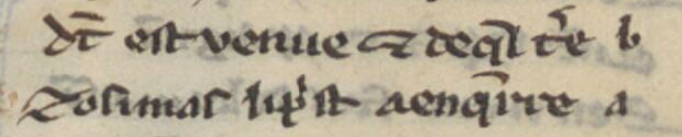
d[on]t est venue & de q[ue]l t[er]e b
Zosimas li p[ri]st a enq[ue]rre a
In Appendix 2, this couplet is rendered statically as it appears in the manuscript, featuring the scribe’s corrective notes while not actually shifting the position of the verses as the scribe has directed.3 In a more enhanced digital environment, such a moment could be rendered dynamically, with the two lines alternating positions on the screen — visually enacting the scribe’s realization and correction in real time. While seemingly minor, cases like this embody the principles this edition seeks to model: respecting the manuscript as a record of both text and process, rendering scribal and editorial interventions not merely knowable but apparent, and encouraging readers to perceive texts as fluid and contingent rather than fixed. Digital methods enable us to preserve and even perform this fluidity in ways that print cannot, foregrounding the medieval scribe’s hand as an active and interpretive presence within the work.
A digital edition can animate a scribe’s micro-level corrections, but not all interventions preserved in manuscripts are so constructive: sometimes manuscripts are altered or damaged in ways that can profoundly shape what material we ultimately read. In the digital edition of T-E presented in Appendix 2, it is obvious that a substantial portion of the text — at least sixty verses in total — is now missing, the consequence of someone having cut out the miniature that once occupied folio 117 verso.4
The fact that copy T-E has been largely overlooked in scholarship is due almost entirely to this single act of mutilation. As Dembowski explains in the introduction to his edition, his choice of T-A as his base text was mainly guided by practicality: the other manuscripts were either too abridged, T-B and T-D, or damaged, T-E and T-L, when compared to T-A, and T-C had already been thoroughly treated in previous editions.5 Yet even in its damaged state, T-E preserves nearly as many verses as T-A, with only about sixty out of what roughly would have been 1,578 verses lost to the excised folio.6 The injury done to this copy is real but limited, and it need not disqualify the manuscript from consideration. What has really marginalized T-E is not just the loss itself but the way print editions have conditioned what we see, and crucially, what we do not see. This cutting in folio 117 is dramatic and unmistakable in the manuscript itself, but when we consider Dembowski’s print edition, the absence is only granted two brief mentions in the variation endnotes,7 preventing the loss of this material from being immediately felt by the reader. Dembowski makes this loss of text known but not apparent. The modern readers of the print edition do not immediately envision this loss. But when encoded as an XML file and rendered as a digital book with each missing verse given space to draw attention, these missing verses become clear, recognizable disruptions that welcome further reflection. The obvious absence of these verses may strike the digital reader with the same sort of shock and curiosity that one might experience when flipping through the mutilated manuscript in the reading room or when clicking through the digitized images of the manuscript’s online surrogate, and the reader of this digital edition might even feel provoked to seek out the manuscript (either via its digitized reproduction or the material original). The digital environment allows us to revisit such exclusions: to interrogate witnesses previously dismissed as deficient and to loosen the long-standing dominance of T-A in Version T studies. Instead of neglecting copy T-E because of the damage done to a single leaf, we can now reintegrate it into the corpus as an essential participant in the text’s transmission history.
T-B presents us with another particularly striking example of loss by way of scribal intervention that would most likely go unnoticed by the reader of a more traditional edition. This copy is significantly shorter than Dembowski’s base text (T-A) — shorter by about 200 verses in total — and closer examination reveals that the scribe did not shorten the text evenly throughout. Instead, the omissions become more and more pronounced toward the end of the narrative as though the scribe had reached the midpoint of copying only to realize they were rapidly running out of room. This phenomenon of accelerating omissions is even observable in the T portraits alone as T-B is missing only four verses from Portrait 1 and sixteen verses from Portrait 2. While Dembowski’s print edition indicates these omissions in his endnotes, it is difficult for even the most attentive of readers to visualize their distribution without alternative visualizations such as the color-coded comparative view presented on the ‘Portraits (with Visualizations)’ page of this dissertation. By leveraging digital editing methods, features like the structure and pacing of omissions may be made far more readily apparent and accessible to modern readers. In this way, readers may not only register the fact of omitted verses but how and why they occur. Has the T-B scribe omitted this or that verse due to an objection with its content or poetic value? Or — as is likely the case here — has the scribe simply found themselves pressed for space and possibly pressed for time? When manuscript evidence is rendered with enhanced clarity, readers can more easily recognize patterns with a discernable scribal rationale — patterns rooted either in an engagement with the text’s content or as a result of the material pressures of the codex’s production.
Yet the line between interpretive choice and material limitation is rarely clean, and scribal interventions can hover ambiguously between the two, leaving the modern editor unsure of how best to present this content to the reader without overstepping. One such instance occurs in Version T at the moment when Mary the Egyptian tells Zozimas that he will find her dead or alive when next they meet (vv.1261-1262). In copy T-B, the scribe has written these existential options on top of one another within the same ruled line — a scribal choice that goes unacknowledged in Dembowski’s edition and even in the Cruz-Sáenz edition that uses T-B as its base text:
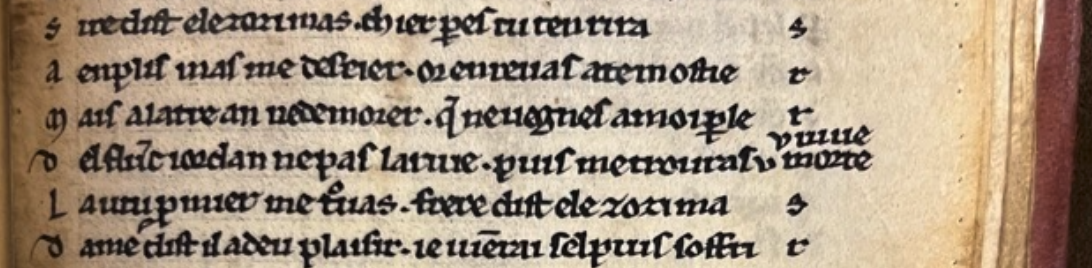
Del flu[n]c Jordan ne pas la rive. puis me trovras \(\begin{array}{c} \text{u vive} \\ \text{u morte} \end{array}\) (vv.1179-1180 in T-B)
It is as though the scribe wanted to emphasize Mary’s simultaneous, ambiguous state as both alive and dead at once. Yes, it is possible this was merely a choice made for the sake of maintaining the spacing of the line — based on the end rhyme of this couplet, it is clear that “u vive” should follow “u morte” — but because this is the only instance in the entire copy where the scribe has stacked words in this way to compress a couplet into a line,8 I see potential here to read this juxtaposition as intentional. It is possible that this small scribal gesture demonstrates a profound understanding of the Christian messaging embedded within this verse as Mary’s state of being is meaningfully paradoxical: while her earthly body may be bound for death down on Earth, her spiritual being is destined for eternal life up in heaven. Regardless of the scribe’s unknowable intentions, the editor is nevertheless left with the practical question of how best to share the fact of this scribal choice in such a way that informs without dictating.9 While digital editing methods may offer more options in how to render this copy — potentially even in a dynamic way with “u vive” bouncing between the outer margin and the interlinear space where it currently sits — verses like this demand first and foremost the expertise and judgment of the human editor. The application of digital technologies does not automatically resolve such fascinating moments of tension to be discovered in the manuscript record — nor should it.
The challenges posed by the examples raised in this conclusion return us to my central concerns. The editing practice developed in this dissertation has been driven by questions like: How can manuscript copies be presented so that editorial choices remain transparent and foster readerly trust without detracting from a fluid and pleasurable reading experience? How can the interpretive potential of enhanced visualizations be maximized without overstepping the role of the editor? And how can readers be invited to make their own choices without eliminating the editor’s guiding hand altogether? Balancing these concerns requires continual calibration and recalibration. The shift from print to digital does not magically solve every challenge; rather, it transforms them. Working digitally does not totally free us from the physical limitations inherent in print media either — it merely reconfigures them. While digital editions are no longer bound by the dimensions of the codex, they introduce other limitations related to screen size — for instance, this digital edition has not been optimized for a mobile user, but should it be? — and the human capacity to focus on only one thing at a time remains an unavoidable issue in any medium. Such factors compel us to think carefully about the design and structure of editions, ensuring they remain both comprehensive and navigable without overwhelming the reader. The utility of any edition, however massive its scope, ultimately depends on the human reader’s ability and desire to engage with it. Although the digital edition presented here offers one viable approach to addressing these challenges, its greatest value may lie in its capacity to be extended and improved. Accordingly, this project has prioritized methods and tools that are open-access and require minimal technical expertise, so that future scholars — regardless of institutional resources — may adapt, refine, and expand upon its foundations. In this way, the edition is less a terminal project than a platform for continued experimentation and collaboration within the field of digital medieval studies.
All of this is a fruitful process, but considerable work remains before a full digital edition and translation of the Version T corpus can be realized. By rendering the complexities of our medieval texts both human- and machine-readable, and by exposing the editorial decisions behind them to greater scrutiny, we move toward a more transparent and participatory model of scholarly editing. The approaches explored in this dissertation are not a cure-all for the fundamental problem of mediation that arises whenever a premodern text is represented to a modern audience. They are, rather, part of a longer continuum of editorial innovation — one that extends from the medieval scribe all the way to the waves of nineteenth and twentieth century medievalist editors and on to the present cohort of print and digital editors experimenting with new ways to understand and share old texts.10 My work joins a growing community of scholars who are confronting similar questions and seeking to rethink how digital tools might illuminate textual and material variance. The editing practice I propose builds upon this collective endeavor: it aims to grant modern readers greater clarity and control in their reading experience and bring the reader closer to the text in question as a body of texts, all the while acknowledging that bridging the gap between modern reader and premodern manuscript is, and will remain, an asymptotic endeavor. We may inch ever closer to the fullness of the T corpus, but no single, static edition could give full voice to a text as layered as the matrix that is Version T of La Vie de sainte Marie l’Égyptienne.
In the Introduction to this dissertation (section ‘Why a Digital Edition of Version T?’), I referenced Duncan Robertson’s own suggestion that print editions based on single manuscripts do not adequately represent medieval texts: “For this work and for most others in the Old French canon, modern editors have chosen rather to present editions based on single manuscripts, emending these as little as possible. … The problem inherent in this approach (by no means unique to St. Mary the Egyptian) is that no one of the extant manuscripts adequately represents the poem. … This factor visibly affects A and B as well as C — more so perhaps than their respective editions acknowledge” (“The Anglo-Norman Verse Life” 31).↩︎
Whearty helpfully models the humility digital humanities scholars must adopt in attempting such projects that must explore possibilities and welcome future improvements, “I hoped, fiercely, that in the next iteration of DMS-Index a new, more skilled contributor would come along to correct my errors and improve my work” (Digital Codicology 204).↩︎
Dembowski notes this scribal correction in his endnotes — “1007: il et sainte f. B, Merci d. i. C, Zosimas li prist a enquerre E, ce vers est placé après le v. 1008, mais sa place correcte est marquée d’un a et d’un b aux vers appropriés — 1008: nee de q. B, iesfnee et d. D, et de q. tere E, ies venue et d. LC —” (97n1007-1008) — but he does not fully demonstrate the variance of this couplet as it appears in T-E where the T-E scribe has written “d[on]t est venue…” (v.1021 in T-E) rather than “Dont es tu nee…” (v.1010 in T-A). Though these verses are rather similar, they are not the same. This incomplete note demonstrates the limitations of relying on the endnotes of a print edition to study variance.↩︎
The lost miniature is connected to the text that follows Version T in this manuscript: the Life of Saint Juliane (ff.117v-121r). The miniature that would have been associated with copy T-E was also cut out (f.113v), but this damage did not result in any loss of text from the beginning of the narrative.↩︎
“Ce choix est grandement simplifié du fait que, comme nous l’avons déjà vu, les mss. B et D donnent des versions très abrégés du récit et que les mss. E et L ont des lacunes considérables. Il ne nous reste donc que A et C. Vu que C est plus récent que A, vu que C a un nombre de leçons inférieures à A, vu que le scribe de A donne un texte très soigné, vu enfin que le texte de C est connu grâce à l’édition de Baker (sans mentionner celle de Cooke), le choix de A s’impose” (30)↩︎
For comparison, T-A has 1,526 verses in total.↩︎
“…E, ce ms. a une coupure qui, à partir de ce vers, va jusqu’au v.1268 —” (104n1236) and “: une coupure dans E —” (105n1289-1318).↩︎
In every other case where the T-B scribe is running out of space for a couplet in the line, the scribe simply continues writing straight into the outer margin, disrupting the copy’s otherwise neat format of both initial and final letter separation.↩︎
For the time being in Appendix 2, I have simply rendered “u vive” in line with “u morte,” placing square brackets around the two to signal something is amiss in this verse. Because copy T-B has not been digitized, including an image from the manuscript in this conclusion provides greater clarity.↩︎
The introduction to Chapter 2 provides a brief history of the editing of Old French texts and connects that history to digital editions currently in production like the Old English Poetry in Facsimile (OEPF) initiative. Chapter 1 situates the rise of the New Philology movement in context with the digital turn that has enabled many to reconceptualize medieval literature as inherently variant and plural.↩︎